Smart Home Security: Top 5 Features for 2025 to Deter Intruders
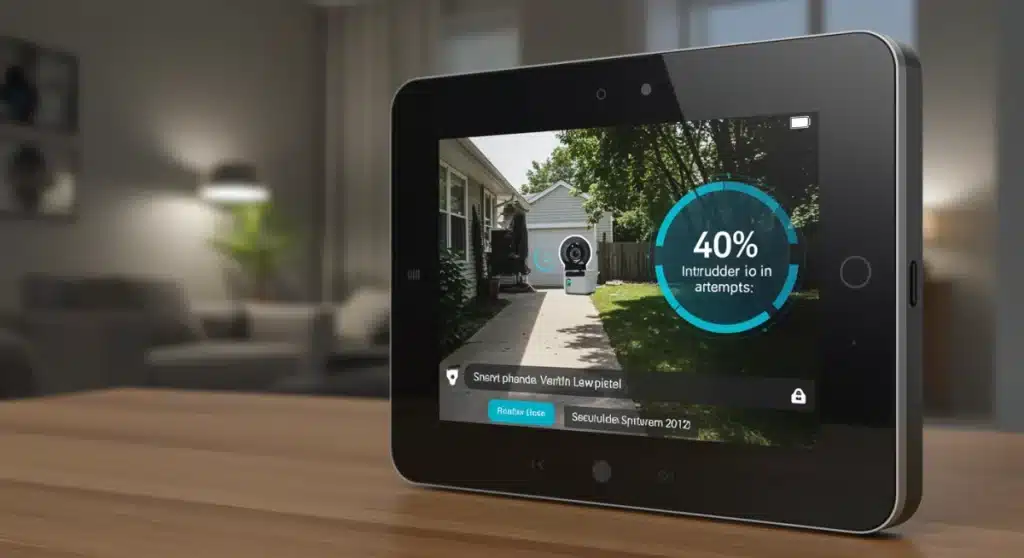
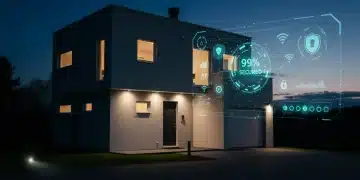
The latest in smart home security systems for 2025 will integrate advanced AI, biometric authentication, and proactive threat detection to significantly deter intruders by up to 40%, fundamentally enhancing overall home safety and providing unparalleled peace of mind.
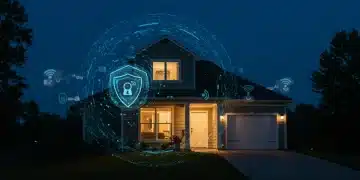
As we approach 2025, the landscape of home security is evolving rapidly, offering unprecedented levels of protection. The latest in smart home security systems are no longer just about alarms; they represent a comprehensive ecosystem designed to proactively safeguard your property and loved ones. Understanding these advancements is crucial for any homeowner looking to bolster their defenses against potential threats.
The Rise of AI-Powered Predictive Analytics
Artificial Intelligence (AI) is transforming smart home security from reactive to proactive, offering capabilities that were once the realm of science fiction. In 2025, AI-powered predictive analytics will be a cornerstone of effective intruder deterrence, analyzing patterns and anomalies to anticipate potential threats before they materialize.
These sophisticated systems learn from historical data, including local crime statistics, weather patterns, and even your family’s routines. By continuously processing this information, they can identify unusual behaviors or environmental shifts that might indicate an elevated risk of intrusion. This foresight allows the system to take pre-emptive actions, significantly reducing the window of opportunity for criminals.
How AI Enhances Detection
AI algorithms are becoming incredibly adept at distinguishing between benign events and genuine threats. This capability minimizes false alarms, a common frustration with older security systems, while ensuring that real dangers are never overlooked.
- Behavioral Recognition: AI can recognize suspicious loitering or unusual vehicle activity around your property.
- Environmental Anomaly Detection: It identifies changes in sound, light, or motion that deviate from normal patterns.
- Pattern Learning: The system learns your daily routines, making it easier to flag deviations as potential threats.
The integration of AI-powered predictive analytics ensures that your smart home security system isn’t just recording events, but actively thinking and adapting to protect your home. This intelligent layer of defense is paramount for achieving the promised 40% deterrence rate against intruders.
Advanced Biometric Authentication and Access Control
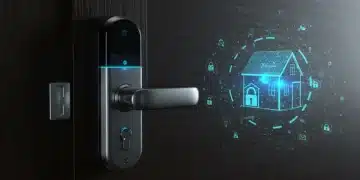
Gone are the days when a simple key or a numerical code was enough to secure your home. In 2025, advanced biometric authentication will redefine access control, making your home significantly more secure. This technology leverages unique biological characteristics to grant or deny entry, offering an unparalleled level of personalization and protection.
Biometric systems, such as fingerprint scanners, facial recognition, and even iris scans, are becoming more affordable and reliable. They eliminate the risks associated with lost keys or shared passcodes, ensuring that only authorized individuals can enter your property. This crucial feature is not only about preventing unauthorized access but also about providing convenience for approved users.
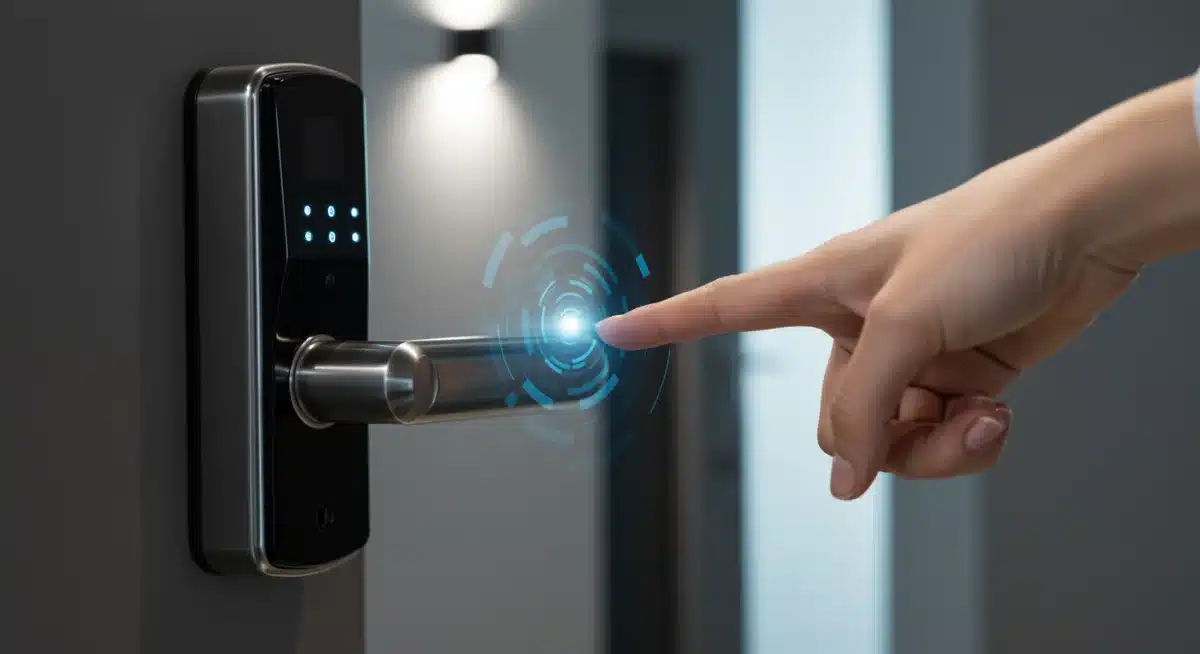
Imagine never having to worry about your children losing their house keys again, or being able to grant temporary access to a pet sitter without compromising your long-term security. Biometric solutions offer this flexibility while maintaining robust security protocols.
Key Biometric Technologies
Several biometric methods are gaining traction for smart home integration, each with its own advantages:
- Fingerprint Recognition: Fast and widely adopted, it’s ideal for quick entry.
- Facial Recognition: Offers hands-free access and can differentiate between individuals, even in varying lighting conditions.
- Voice Authentication: While less common for primary entry, it’s excellent for secondary verification within the home system.
The evolution of these technologies means greater accuracy and resilience against spoofing attempts, further solidifying their role in deterring intruders. As they become standard, biometric authentication will significantly enhance the overall security posture of smart homes.
Integrated Drone Surveillance and Perimeter Defense
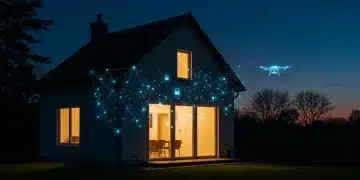
The concept of a perimeter defense for your home is being revolutionized by the introduction of integrated drone surveillance. By 2025, smart home security systems will incorporate autonomous drones as a vital component of their outer defense, providing a dynamic and comprehensive view of your property’s surroundings.
These drones are not merely toys; they are programmed to patrol your property, responding to triggers from motion sensors, AI analytics, or even user commands. Equipped with high-resolution cameras, thermal imaging, and two-way audio, they can provide real-time aerial footage and communicate with potential intruders, often deterring them before they even reach your physical structure.
Advantages of Drone Surveillance
Drone surveillance offers unique benefits that traditional static cameras cannot match, providing an adaptable and mobile security layer.
- Dynamic Patrols: Drones can cover large areas quickly and efficiently, adjusting their routes based on detected threats.
- Real-time Aerial Views: Provides a bird’s-eye perspective, useful for identifying hidden approaches or multiple intruders.
- Auditory Deterrence: Two-way audio allows you to issue warnings, often enough to scare off potential threats.
The integration of drones into smart home security systems represents a significant leap forward in proactive defense. Their ability to respond to threats and provide comprehensive oversight of your property’s perimeter makes them an invaluable asset in deterring intruders and enhancing overall safety.
Quantum-Resistant Encryption for Data Security
As smart homes become more interconnected, the security of the data they generate and transmit becomes paramount. In 2025, smart home security features will include quantum-resistant encryption, a critical advancement designed to protect your personal information and system integrity from increasingly sophisticated cyber threats, including those posed by future quantum computers.
Current encryption methods, while robust, could potentially be vulnerable to quantum computing in the future. Quantum-resistant encryption proactively addresses this by employing cryptographic algorithms that are secure against both classical and quantum attacks. This ensures that your camera feeds, access logs, and personal data remain private and tamper-proof, safeguarding not just your physical home but your digital footprint as well.
Why Quantum-Resistant Encryption Matters
Protecting your smart home data is as important as securing your physical property. A compromised system can lead to privacy breaches or even provide intruders with information about your routines.
- Future-Proof Security: Protects against potential threats from quantum computers that could break current encryption standards.
- Data Integrity: Ensures that video feeds, sensor data, and access controls cannot be manipulated or intercepted.
- Privacy Protection: Safeguards sensitive personal information stored within your smart home ecosystem.
By adopting quantum-resistant encryption, smart home security systems are not only addressing today’s cyber threats but also anticipating and neutralizing tomorrow’s. This commitment to data security is essential for building trust and ensuring the long-term reliability of your smart home’s protective measures.
Self-Healing Networks and Redundant Systems
Reliability is a non-negotiable aspect of any effective security system. In 2025, smart home security systems will feature self-healing networks and redundant systems, ensuring continuous operation even in the face of disruptions. This means your home remains protected, regardless of power outages, internet failures, or component malfunctions.
Self-healing networks are designed to automatically detect and repair issues within the system, rerouting data or activating backup components without human intervention. Redundant systems, on the other hand, involve duplicating critical hardware and software components, so if one fails, a backup immediately takes over. This dual approach guarantees an uninterrupted security presence, vital for peace of mind.
Consider a scenario where a power surge takes out a primary sensor. A self-healing network would instantly activate a backup sensor or reconfigure existing ones to cover the affected area. Similarly, if your internet connection drops, redundant cellular or satellite links would ensure that your security system remains connected to monitoring services.
Ensuring Uninterrupted Protection
The robustness provided by self-healing and redundant systems is crucial for maintaining a truly secure smart home.
- Power Outage Resilience: Battery backups and alternative power sources ensure continuous operation.
- Internet Redundancy: Automatic switching to cellular or satellite connections if the primary internet fails.
- Component Fault Tolerance: Duplicated hardware and software prevent single points of failure.
These advanced features underscore a commitment to unwavering security, ensuring that your smart home is always vigilant. The ability of these systems to maintain operational integrity under adverse conditions is a key factor in their effectiveness at deterring intruders.
Proactive Deterrence and Emergency Response Integration
Beyond detection and prevention, the latest smart home security systems in 2025 will excel in proactive deterrence and seamless emergency response integration. These systems are designed to actively discourage intruders and, if an intrusion does occur, ensure the fastest possible response from authorities.
Proactive deterrence involves a range of features, from intelligent lighting that mimics occupancy to automated voice warnings and even non-lethal sonic deterrents. These actions are triggered automatically by the system’s AI when a potential threat is identified, making the home appear less vulnerable and often prompting intruders to move on.
Furthermore, these systems will be deeply integrated with local emergency services. In the event of a confirmed intrusion, the system can automatically alert police, providing them with real-time video feeds, entry points, and even the number of individuals detected. This streamlined communication significantly reduces response times, a critical factor in mitigating damage and ensuring safety.
Features for Enhanced Deterrence and Response
A combination of intelligent actions and efficient communication makes these systems incredibly effective.
- Smart Lighting and Sound: Automated lights and sounds simulate occupancy, making the home less appealing to intruders.
- Automated Warnings: Pre-recorded messages or live two-way audio can directly address potential threats.
- Direct Emergency Dispatch: Immediate and detailed alerts sent directly to police or fire departments.
The integration of proactive deterrence and rapid emergency response ensures that your smart home security system is not just a silent observer but an active participant in your home’s defense. This comprehensive approach is key to achieving significant reductions in intrusion rates and providing ultimate peace of mind.
| Key Feature | Brief Description |
|---|---|
| AI-Powered Analytics | Predicts and deters threats by analyzing patterns and anomalies. |
| Biometric Access | Uses unique biological traits for secure and personalized home entry. |
| Drone Surveillance | Autonomous drones patrol property, providing dynamic aerial monitoring. |
| Quantum Encryption | Secures smart home data against future cyber threats, including quantum computing. |
Frequently Asked Questions About Smart Home Security
AI-powered predictive analytics in home security uses artificial intelligence to analyze various data points, such as local crime rates, weather, and your routines, to identify potential threats before they occur. This proactive approach allows the system to take preventive measures, significantly enhancing deterrence.
Biometric authentication systems, like fingerprint or facial recognition, improve security by ensuring that only authorized individuals can access your home using unique biological identifiers. This eliminates the risks associated with lost keys or shared codes, making unauthorized entry extremely difficult and personalizing access control.
Yes, integrated drone surveillance can effectively deter intruders. Autonomous drones equipped with cameras and two-way audio can patrol your property, respond to alerts, provide real-time aerial footage, and even issue verbal warnings, making your home a less appealing target for criminals.
Quantum-resistant encryption is crucial for future-proofing smart home security by protecting data from advanced cyber threats, including those posed by quantum computers. It ensures that your private information, camera feeds, and system controls remain secure and cannot be breached or manipulated by sophisticated attacks.
Self-healing networks in smart home security are systems designed to automatically detect and rectify operational issues, such as network outages or component failures. They ensure continuous and uninterrupted protection by rerouting data or activating backup systems, maintaining your home’s security even during disruptions.
Conclusion
The evolution of smart home security systems by 2025 signifies a paradigm shift from basic alarms to comprehensive, intelligent defense ecosystems. The integration of AI-powered predictive analytics, advanced biometric authentication, integrated drone surveillance, quantum-resistant encryption, and self-healing networks collectively forms an formidable barrier against intruders. These cutting-edge features not only promise to deter potential threats by a significant margin but also offer homeowners an unprecedented level of peace of mind. Investing in these advanced technologies means embracing a future where your home’s safety is proactive, resilient, and virtually impenetrable, ensuring a secure environment for your family and assets.