Smart Home Data Privacy: 2025 Trends & US Solutions
Navigating the data privacy landscape in smart homes is crucial for US users, with 2025 trends focusing on enhanced security protocols, user-centric controls, and regulatory compliance to safeguard personal information.
As our homes become increasingly connected, the question of privacy looms larger than ever. For US users, understanding how to protect personal information in a smart home is not just a convenience, but a necessity. This article delves into the essential trends of 2025 for smart home data privacy, offering practical solutions to navigate this evolving landscape.
Understanding the Evolving Smart Home Data Landscape
The smart home ecosystem is growing at an unprecedented pace, integrating devices from security cameras to voice assistants, thermostats, and even smart appliances. Each of these devices collects data, often in vast quantities, ranging from usage patterns and preferences to highly sensitive personal information like facial recognition data or audio recordings.
This constant stream of data forms the backbone of smart home functionality, enabling automation, personalized experiences, and remote control. However, it also presents a complex challenge: how to harness the benefits of connectivity without compromising individual privacy. The regulatory environment in the US is continually adapting to these technological advances, but proactive user engagement remains paramount.
The Proliferation of Data Points
Every interaction with a smart device generates a data point. A smart thermostat records your heating and cooling preferences, a smart speaker logs your voice commands, and a smart lock tracks entry and exit times. This granular data, when aggregated, can paint a detailed picture of your daily life, habits, and even your presence or absence from home.
- Behavioral Data: Insights into routines, preferences, and usage patterns.
- Biometric Data: Facial recognition, fingerprints, and voiceprints for authentication.
- Location Data: Tracking movement within and outside the home.
- Location Data: Tracking movement within and outside the home.
- Environmental Data: Temperature, humidity, and air quality information.
The Value and Vulnerability of Your Data
While this data is invaluable for enhancing smart home functionality, it also holds significant value for third parties, including advertisers, data brokers, and even potential malicious actors. The more data collected, the greater the potential for misuse or security breaches. Understanding this inherent vulnerability is the first step in implementing robust privacy measures.
The evolving landscape demands a critical eye on data collection practices, ensuring that users are aware of what data is being gathered, how it is being used, and with whom it is being shared. This awareness empowers users to make informed decisions about their smart home configurations and device choices.
Enhanced Encryption and Decentralized Data Storage
One of the most significant trends for 2025 in smart home data privacy is the move towards stronger encryption and decentralized data storage solutions. Traditional cloud-based storage, while convenient, presents a single point of failure that can be attractive to cybercriminals. Decentralization aims to distribute data across multiple nodes, making it harder to compromise.
Encryption, on the other hand, scrambles data so that it can only be accessed by authorized parties. As smart home technology advances, so too does the sophistication of encryption methods, offering a more robust defense against unauthorized access.
The Power of End-to-End Encryption
End-to-end encryption ensures that data is encrypted at the source and remains encrypted until it reaches its intended recipient, preventing eavesdropping or tampering along the way. For smart home devices, this means that conversations with voice assistants or video feeds from security cameras are protected from your device to the cloud server and back.
- Secure Communications: Protecting voice commands and video streams.
- Data Integrity: Ensuring data has not been altered during transit.
- Reduced Risk: Minimizing exposure to interception by third parties.
Decentralized Architectures for Smart Homes
Beyond encryption, decentralized data storage is gaining traction. Instead of relying solely on a central cloud server, some smart home systems are beginning to store data locally on devices or distribute it across a peer-to-peer network. This approach can reduce the risk associated with large-scale data breaches.
While still in its nascent stages for many consumer-grade smart home devices, the principle of decentralization offers a promising avenue for enhanced privacy. It places more control over data directly in the hands of the user, rather than a single corporate entity.
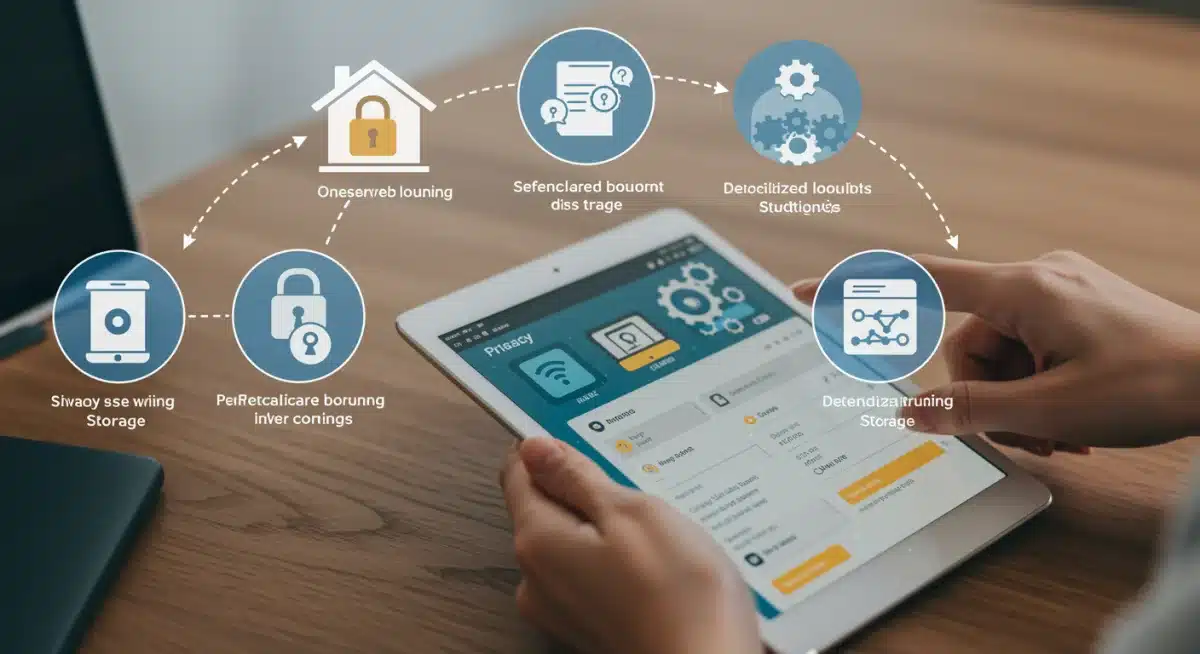

User-Centric Privacy Controls and Transparency
In 2025, smart home device manufacturers are increasingly focusing on providing users with more granular and intuitive privacy controls. This shift is driven by both consumer demand and emerging regulatory pressures. Users expect to understand what data is collected, how it’s used, and to have easy ways to manage their privacy preferences.
Transparency is key; companies are being pushed to offer clear, concise explanations of their data practices, moving away from dense, legalese-filled privacy policies that few users actually read. This empowers US users to make informed choices about their connected devices.
Simplified Privacy Dashboards
Expect to see more sophisticated yet user-friendly privacy dashboards. These central hubs will allow users to review and adjust data collection settings for all their connected devices in one place. This includes options to opt-out of certain data sharing, delete historical data, or even limit the types of data collected.
- Centralized Management: Control all device privacy settings from a single interface.
- Data Deletion Options: Easily remove personal data stored by devices.
- Opt-Out Capabilities: Choose not to share certain types of data with third parties.
Clearer Data Usage Explanations
Manufacturers are beginning to provide clearer explanations about why specific data is collected and how it benefits the user. For instance, instead of a vague statement about improving services, a company might explain that motion sensor data is used to optimize energy consumption or that voice commands are processed locally for faster responses.
This level of transparency builds trust and helps users understand the trade-offs between convenience and privacy. It allows for a more informed decision-making process when configuring their smart home ecosystems.
The Impact of Regulatory Frameworks on Smart Home Privacy
The regulatory landscape in the US is a patchwork of state and federal laws, with new legislation continually being proposed and enacted. These frameworks play a crucial role in shaping smart home data privacy practices, compelling manufacturers and service providers to adhere to stricter standards for data collection, storage, and usage.
Understanding these regulations, such as California’s CCPA/CPRA, and potential federal privacy laws on the horizon, is essential for both consumers and companies operating in the smart home space.
State-Level Privacy Initiatives
States like California, Virginia, and Colorado have led the way with comprehensive privacy laws that grant consumers specific rights over their personal data. These laws often include provisions for data access, deletion, and the right to opt-out of data sales. As more states adopt similar legislation, a more uniform standard of data protection may emerge.
These state-level initiatives often set a precedent for future federal regulations, pushing the entire industry towards greater accountability and user protection. Consumers in these states benefit from stronger legal safeguards for their smart home data.
The Push for Federal Privacy Legislation
There is a growing bipartisan call for a comprehensive federal privacy law in the US. Such legislation would provide a consistent framework across all states, simplifying compliance for businesses and ensuring a baseline level of protection for all US citizens. While progress has been slow, the increasing prevalence of smart home technology makes such a law more urgent.
A federal law could standardize requirements for data minimization, security safeguards, and transparency, significantly impacting how smart home devices handle user data. This would create a more predictable and secure environment for smart home adoption.
AI and Machine Learning: Balancing Personalization with Privacy
Artificial intelligence (AI) and machine learning (ML) are at the heart of many smart home functionalities, enabling devices to learn user preferences, anticipate needs, and automate tasks. While these technologies drive personalization and convenience, they also raise significant privacy concerns due to their ability to process and infer highly personal information from vast datasets.
The challenge for 2025 is to leverage the power of AI and ML for smart home enhancements while ensuring robust privacy protections are in place, preventing unintended data exposure or misuse.
On-Device AI Processing (Edge Computing)
A key trend addressing AI privacy concerns is the shift towards on-device AI processing, also known as edge computing. Instead of sending all data to the cloud for analysis, more smart devices are performing AI computations locally. This significantly reduces the amount of sensitive data transmitted over networks and stored on remote servers.
- Reduced Cloud Reliance: Less data leaves the home network.
- Faster Response Times: Local processing eliminates latency.
- Enhanced Privacy: Sensitive data remains on the device.
Federated Learning and Privacy-Preserving AI
Federated learning is another promising approach where AI models are trained on decentralized datasets located on individual devices, without the raw data ever leaving the user’s home. Only the learned model parameters are shared with a central server, preserving individual data privacy while still allowing for collective intelligence.
This technique allows smart home systems to improve their AI capabilities by learning from a broad user base without directly accessing or centralizing sensitive personal data. It represents a significant step forward in balancing AI-driven personalization with robust privacy safeguards.
Practical Solutions for US Users: Protecting Your Smart Home
Beyond understanding the trends, US users need actionable strategies to protect their smart home data privacy. Implementing a multi-layered approach, combining smart device choices with diligent network security and informed usage habits, is the most effective defense.
Taking control of your smart home’s privacy posture requires a proactive mindset, but the effort is well worth the peace of mind that comes with knowing your personal information is secure.
Securing Your Network and Devices
Your home Wi-Fi network is the gateway to your smart home. Securing it is the first and most critical step. Use strong, unique passwords for your router and all smart devices. Enable two-factor authentication (2FA) wherever possible, and regularly update firmware on all devices to patch security vulnerabilities.
- Strong Passwords: Unique and complex for router and devices.
- Two-Factor Authentication (2FA): Add an extra layer of security.
- Regular Firmware Updates: Keep devices protected against known exploits.
- Guest Wi-Fi Network: Isolate smart devices from your main network.
Making Informed Device Choices and Managing Settings
Before purchasing a smart device, research its privacy policy and data collection practices. Choose reputable brands known for their commitment to security. Once installed, delve into the device’s privacy settings. Disable features you don’t use, limit data sharing, and review access permissions granted to apps.
Regularly audit your smart home ecosystem, removing unused devices and reviewing the privacy settings of active ones. This ongoing vigilance ensures that your smart home remains aligned with your privacy preferences.
The Future of Smart Home Privacy: A Collaborative Effort
The journey towards a truly private and secure smart home ecosystem is a collaborative one, involving manufacturers, regulators, and consumers. As we move further into 2025, the emphasis will continue to be on building trust through transparent practices, robust security measures, and empowering user controls.
For US users, staying informed about new technologies, understanding their rights, and actively managing their smart home settings will be crucial. The future promises even more integrated and intelligent homes, but this must be built on a foundation of respect for personal data and privacy.
Industry Standards and Certifications
Expect to see increased adoption of industry-wide privacy and security standards, along with clear certification programs. These certifications will help consumers identify devices that meet stringent data protection requirements, simplifying the decision-making process.
Such initiatives can provide a benchmark for security, giving consumers confidence that certified devices adhere to best practices for safeguarding personal information.
Consumer Advocacy and Education
Consumer advocacy groups will continue to play a vital role in pushing for stronger privacy protections and educating the public about smart home risks and best practices. Informed consumers are better equipped to demand privacy-respecting products and influence policy decisions.
Education empowers users to ask the right questions, understand complex privacy policies, and configure their smart homes in a way that aligns with their comfort levels and security needs.
| Key Aspect | Brief Description |
|---|---|
| Encryption & Decentralization | Enhanced data scrambling and distributed storage reduce breach risks. |
| User-Centric Controls | Intuitive dashboards and clear policies empower users to manage data. |
| Regulatory Impact | State and potential federal laws drive stricter data protection standards. |
| AI & Edge Computing | On-device AI processing minimizes cloud data transfer, boosting privacy. |
Frequently Asked Questions About Smart Home Data Privacy
End-to-end encryption ensures that data is encrypted on your device and remains encrypted until it reaches its intended recipient, like a smart home server. This prevents unauthorized parties from intercepting and reading your sensitive information, such as voice commands or video feeds, safeguarding your privacy.
For US users, strengthening smart home network security involves several steps. Use strong, unique passwords for your Wi-Fi and devices, enable two-factor authentication, and regularly update device firmware. Consider setting up a separate guest Wi-Fi network to isolate smart devices from your main network, adding an extra layer of protection.
User-centric privacy controls refer to intuitive interfaces that allow you to easily manage your smart home’s data collection and sharing settings. This includes privacy dashboards to review permissions, options to delete historical data, and clear explanations of how your data is used, empowering you to make informed decisions.
State privacy laws, such as California’s CCPA/CPRA, grant US consumers specific rights over their personal data collected by smart home devices. These rights include access to your data, the ability to request its deletion, and the option to opt-out of data sales, providing stronger legal safeguards for your information.
On-device AI processing, or edge computing, means that artificial intelligence computations happen directly on your smart device rather than sending all data to the cloud. This is crucial for privacy because it significantly reduces the amount of sensitive personal data transmitted over the internet and stored on remote servers, keeping your information local and more secure.
Conclusion
Navigating the data privacy landscape in a smart home environment is becoming increasingly complex, yet manageable, for US users. The trends of 2025 point towards a future where enhanced encryption, decentralized data storage, and user-centric controls become standard. By staying informed about these advancements, understanding regulatory frameworks, and actively implementing practical security measures, consumers can enjoy the benefits of a connected home without compromising their personal information. The responsibility lies not only with manufacturers and policymakers but also with each individual to proactively safeguard their digital lives in an ever-evolving smart home world.